November 2026
Are Heat Pumps Worth It?
Find out whether a heat pump is worth it for your home, covering savings, grants, payback time, and suitability.
Written by:


For most well-insulated homes, a heat pump can be worth it over its lifetime. It's far more efficient than a gas boiler, lasts longer, and cuts your home's carbon. Government grants can also bring the upfront cost down. But a heat pump isn't the right fit for every home straight away. Your savings depend on your home, your current heating, and your energy tariff. Here's how to work out if it's worth it for you.
What Does "Worth It" Mean for a Heat Pump?
There's no single number that tells you if a heat pump is worth it. It's more of a balance. It helps to weigh up five things:
- the upfront cost, once any grant is taken off
- how much you could save on your energy bills
- how long it takes to pay for itself
- how much carbon you could cut
- how warm and comfortable your home feels
We'll go through each one below, so you can decide what matters most to you.
Could a Heat Pump Save You Money?
Heat pumps are very efficient. They can make three to four units of heat from every unit of electricity they use.¹ A modern gas boiler is around 90% efficient.
But electricity costs more per kWh than gas. So whether you save money depends on a few things:
- What you're replacing. You're likely to save the most if you're moving away from oil, liquefied petroleum gas (LPG), or older electric heating. Savings against a modern gas boiler are usually smaller.
- How well insulated your home is. Heat pumps work best at lower, steady temperatures. Good insulation keeps that heat in.
- Your energy tariff. A time-of-use tariff, where prices change depending on when you use electricity, can lower your running costs.
- How you heat your home. How many people live there, and how often the heating is on, both make a difference.
Get a quote for your home with one of our trusted installers, Heat Geek or Installio.
Grants That Can Reduce the Cost
If you live in England or Wales, the Boiler Upgrade Scheme can take a grant off the cost of a heat pump.² It's open to most homeowners who are replacing an existing heating system, like a gas, oil, or LPG boiler.
You don't apply for it yourself. Your installer applies for you, and the grant comes off your quote.³ The installer must be certified by the Microgeneration Certification Scheme (MCS).
If you live in Scotland, you might be able to get an interest-free loan or grant through Home Energy Scotland.
How Long Is the Payback Period?
The payback period is how long it takes for your savings to cover what you paid. Here's how to work it out:
- Start with the cost of your installation.
- Take off any grant.
- Divide what's left by how much you save on heating each year.
The answer depends on your home, so there isn't one figure that fits everyone.
Your payback period is likely to be shorter if:
- you get a grant
- you're replacing an expensive fuel, like oil or LPG
- your home is well insulated
- you're on an energy tariff that suits a heat pump
It's likely to be longer if:
- your home needs extra work first, like new radiators
- you're replacing a newer gas boiler
- energy prices change in a way that narrows the gap between gas and electricity
It's also worth remembering that you'd need to replace a boiler at some point anyway. So it's fairer to compare a heat pump with the cost of a new boiler. Most heat pumps also last over 20 years, compared to 10 to 15 years for a typical modern boiler.⁴
Is Your Home Suitable?
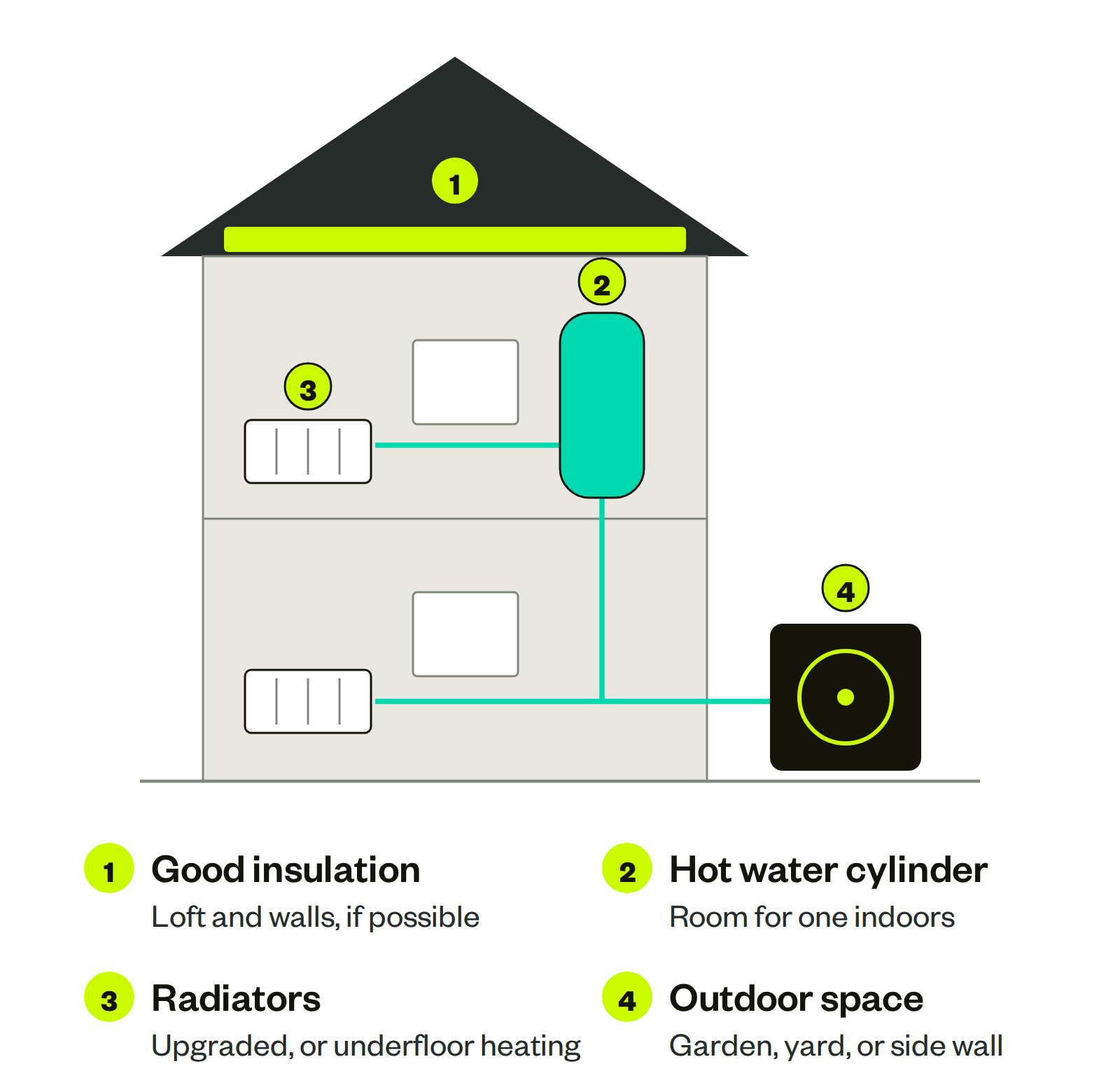
A heat pump is likely to suit your home if:
- it's reasonably well insulated, with loft and wall insulation where possible
- you have radiators that can be upgraded if needed, or underfloor heating
- you have outdoor space for the unit, like a garden, yard, or side wall
- you have room inside for a hot water cylinder
If your home is older or not well insulated, a heat pump can still work. You might need some work first, like adding loft insulation or fitting bigger radiators. A home survey will show you exactly what your home needs.
Planning Permission and Installer Certification
In England, most air source heat pumps don't need planning permission. They count as permitted development, which means you can go ahead without applying.⁵
There are some conditions. The outdoor unit has to stay within a size limit, and it has to meet MCS noise standards.⁵ You're more likely to need planning permission if:
- you live in a listed building
- your council has removed permitted development rights in your area
- you want more than one unit, or two on a detached home
- you live in a flat
Wales and Scotland have their own rules, so check with your local council before you go ahead.
Using an MCS-certified installer matters for three reasons. Certified installers have to meet set standards for design and installation. You need one to get the Boiler Upgrade Scheme grant. And in England, your heat pump must meet MCS standards to count as permitted development.⁵
So Energy Heat Pump Installation Service
If a heat pump sounds right for you, the next step is a home survey. It's the only way to get a clear view of costs, savings, and suitability for your home.
We've partnered with two heat pump experts, Heat Geek and Installio. Both have nationwide networks of certified installers. You choose the partner that suits you best.
Your partner will:
- survey your home and recommend the right system
- check if you're eligible for a government grant
- help you apply for the grant
- give you a personalised quote
- install your heat pump system
- comprehensive, ongoing aftercare support
There's a fee for the survey or design consultation, which is refunded through your installation if you go ahead.
Find out more about our partners
Heat Pump Value FAQs
Are Heat Pumps Worth It for an Old or Poorly Insulated House?
They can be. Heat pumps work best when heat stays in, so older homes often need some work first. That might mean adding loft or wall insulation, sealing draughts, or fitting bigger radiators. This adds to the upfront cost, but it also makes your home warmer and cheaper to heat. A home survey will show what your home needs before you decide.
Do Heat Pumps Actually Save Money on Energy Bills?
Often, yes, but it depends on your home. You're likely to save the most if you're replacing oil, LPG, or older electric heating. Savings against a modern gas boiler are usually smaller. Your insulation and energy tariff matter too.
What Grants Are Available for a Heat Pump?
In England and Wales, the Boiler Upgrade Scheme can take a grant off the cost of a heat pump. Your MCS-certified installer applies for you. In Scotland, Home Energy Scotland may offer a loan or grant.
How Long Does It Take for a Heat Pump to Pay for Itself?
It depends on your home, so there's no single answer. The main things that affect it are the cost after any grant, the fuel you're replacing, and how well insulated your home is. Your energy tariff and future energy prices play a part too. A heat pump also lasts longer than a boiler, which adds to its value over time.
Do I Need Planning Permission for a Heat Pump?
Usually not. In England, most air source heat pumps count as permitted development. The unit must meet size and noise rules, and be installed to MCS standards. You may need permission if you live in a listed building, a flat, or an area where permitted development rights have been removed. Wales and Scotland have their own rules.
Sources
- Energy Saving Trust, In-depth guide to heat pumps: https://energysavingtrust.org.uk/advice/in-depth-guide-to-heat-pumps
- https://www.gov.uk/apply-boiler-upgrade-scheme
- Energy Saving Trust, Boiler Upgrade Scheme: https://energysavingtrust.org.uk/advice/boiler-upgrade-scheme/
- Energy Saving Trust, Heat pump questions answered: https://energysavingtrust.org.uk/heat-pump-questions-answered/
- Planning Portal, Planning permission: air source heat pump: https://www.planningportal.co.uk/permission/common-projects/heat-pumps/planning-permission-air-source-heat-pump/
Should I Get a Smart Meter Installed In My Home?
Getting a smart installed in your home is both a free and smart move to make.
With a smart meter, you get real-time information about your energy usage, allowing you to make smarter choices and potentially save on your bills. Plus, it can help reduce the nation's carbon footprint and bring us closer to a greener future.
Stay Plugged Into Our Latest News & Views
We publish news regularly, keeping you informed on new products, industry changes and more.
Are Heat Pumps Worth It?
Find out whether a heat pump is worth it for your home, covering savings, grants, payback time, and suitability.

How do heat pumps work?
Find out how heat pumps work, from taking warmth from the air or ground outside to heating your radiators and hot water.

EV Charger Installation Guide: What You Need to Know
Thinking about installing an EV charger at home? Find out what it costs, the rules you need to follow, and how the installation works, step by step.
Home EV charger: buying guide
Compare home EV chargers by speed, tethered or untethered, smart features and cost, and learn how to choose the right electric car charger for your home.

How do solar batteries work and store energy?
Find out how solar batteries store energy, the different battery types available, and how they help lower your energy bills.

So Energy earns the 2026 Uswitch Flex Accreditation
So Energy's So EV and So Unique tariffs have been awarded the 2026 Uswitch Flex Accreditation. See what the award means and how flexible tariffs cut bills.
How much does it cost to charge an electric car at home?
Understand how using a smart charger combined with an EV tariff could save you hundreds on EV charging at home.